A cheap pottery wheel can be worth buying if you treat it as a way to learn, not a lifetime machine. The VEVOR 14 in 450 W is the best value under $250: it has a 14 in head, a pedal, reverse and adjustable height. If you can spend $400 to $1,400, a branded wheel buys you published capacity ratings and real warranties. This guide covers both, with an honest look at VEVOR and the point where stretching your budget makes sense.
This guide is research-based. We compared maker product pages, published specs, dealer listings and owner reports. We did not test these wheels ourselves. Every figure below matches our other wheel guides, and where a maker does not publish a number, we say so.
Quick picks
- Best cheap pottery wheel overall: VEVOR 14 in 450 W (full-size head, pedal, reverse, lift-top legs)
- Cheapest real electric wheel: VEVOR 11 in 350 W
- Cheap wheel that starts from 0 rpm: VEVOR 9.8 in 350 W LCD
- Cheapest with a stated warranty: U.S. Art Supply PW-101
- First step up to a branded wheel: Speedball Artista
- Budget full-size wheel with published capacity: BTH Sirius BP02
- Worth stretching for: Speedball Clay Boss
Budget pottery wheels compared
| Wheel | Motor | Head | Speed | Capacity | Warranty | Price band (Oct 2026) | Buy |
|---|---|---|---|---|---|---|---|
| VEVOR 14 in 450 W | 450 W brushless | 14 in | 60 to 300 rpm | Not published | Not stated | $150 to $250 | Check price |
| VEVOR 11 in 350 W | 350 W brushless | 11 in | 60 to 300 rpm | Not published | Not stated | $120 to $200 | Check price |
| VEVOR 9.8 in 350 W LCD | 350 W brushless | 9.8 in | 0 to 300 rpm | About 4 kg (Q&A only) | Not stated | About $100 to $150 | Check price |
| U.S. Art Supply PW-101 | 3/4 HP | 11 in | Up to 300 rpm | Not published | 1 year limited | $400 to $600 | Check price |
| Speedball Artista | 1/3 HP | 11 in | 0 to 220 rpm | 25 lb | 5 years | $600 to $750 | Check price |
| BTH Sirius BP02 | 500 W brushless DC | 12 in | 0 to 300 rpm | 88 lb | 5 years | $850 to $1,060 | Check price |
| Speedball Clay Boss | 0.5 HP | 14 in | 0 to 240 rpm | 100 lb | 10 years | $1,150 to $1,400 | Check price |
1. VEVOR 14 in 450 W: best cheap pottery wheel overall

This is the budget wheel most people should buy. VEVOR lists a 450 W brushless motor, a 14 in aluminum alloy wheelhead, 60 to 300 rpm, clockwise and counterclockwise rotation set from buttons on the control panel, and a water-resistant foot pedal. The legs lift the top by 0 to 6 in, so you can set a comfortable seated height, and VEVOR rates it at 60 dB. A detachable ABS basin, 16 tools (eight steel, eight wood), an apron and a hex wrench come in the box. The model number on VEVOR's page is LSFD-515.
The 14 in head is the real advantage. It is the same size as the heads on wheels costing five to eight times more, which gives room for wide bowls and small plates. The gaps are in the paperwork: no published centering capacity, no stated standard warranty, no hand speed control (VEVOR's Q&A confirms pedal only) and, per the same Q&A, no pre-drilled bat pin holes.
- Motor: 450 W brushless
- Wheelhead: 14 in aluminum alloy
- Centering capacity: not published by the maker
- Speed: 60 to 300 rpm, pedal only
- Reverse: yes
- Weight: 36.3 lb
- Height: lift-top, 0 to 6 in
- Price band: typically $150 to $250 in October 2026; check the live price
Pros
- Full-size head for the price
- Pedal and reverse
- Adjustable height
- Tools included
Cons
- No published capacity
- No clear standard warranty
- 60 rpm minimum
- No bat pin holes
Who should skip it: anyone who already knows they will throw several times a week for years. Spend once on a branded wheel instead.
2. VEVOR 11 in 350 W: cheapest real electric wheel

If your goal is simply to find out whether you like throwing, the 11 in VEVOR (model LSSJ-515) is about as cheap as a real electric wheel gets. VEVOR lists a 350 W brushless motor, an 11 in aluminum alloy head, 60 to 300 rpm, a direction switch for reverse, a waterproof foot pedal, a detachable ABS basin and the same 16 tools, at 30.9 lb and 60 dB.
VEVOR's current 11 in page also lists a 0 to 6 in lift-top, which older versions did not have, so check the listing you are buying from. It handles small cups and bowls. It is not a wheel to grow into: the motor is smaller than the 14 in model's, the head limits plate size, and there is no published capacity or standard warranty. The 14 in usually costs only a little more, which is why we rank it first.
- Motor: 350 W brushless
- Wheelhead: 11 in aluminum alloy
- Centering capacity: not published by the maker
- Speed: 60 to 300 rpm
- Weight: 30.9 lb
- Price band: typically $120 to $200 in October 2026; check the live price
Pros
- Lowest cost
- Light enough to store
- Pedal and reverse included
Cons
- Smallest motor of the full VEVOR wheels
- No capacity or warranty figure
Who should skip it: anyone sure they want to keep throwing. The 14 in model has a bigger motor and head for little more.
3. VEVOR 9.8 in 350 W LCD: cheap wheel that starts from 0 rpm

This smaller VEVOR (model GCJX-008) fixes the one spec that bothers experienced potters about the 11 in and 14 in models: its speed runs from 0 to 300 rpm instead of starting at 60. VEVOR lists a 350 W brushless motor, a 9.8 in turntable, clockwise and counterclockwise rotation, a waterproof LCD touch screen, a 110V supply, 26.5 lb and 19.7 x 13.8 x 11.2 in. It is also the only VEVOR wheel here with a clay figure: an answer in the page's Q&A gives about 4 kg (about 8.8 lb), though that is not in the spec table.
VEVOR describes manual and foot pedal modes, but the package list on the page we checked names only the machine, a tool set and a manual, so confirm the pedal is in the box before you order. The page also lists 30-day free returns. The small head limits you to cups, small bowls and practice cylinders.
- Motor: 350 W brushless
- Wheelhead: 9.8 in
- Clay limit: about 4 kg per VEVOR Q&A
- Speed: 0 to 300 rpm
- Weight: 26.5 lb
- Price band: about $100 to $150 on VEVOR's site in October 2026; check the live price
Pros
- True slow speeds for trimming
- Compact
- A clay figure, if only from the Q&
- A
Cons
- Small head
- Pedal inclusion unclear on the listing
- No stated warranty
Who should skip it: anyone who wants to throw plates or wide bowls.
4. U.S. Art Supply PW-101: cheapest with a stated warranty
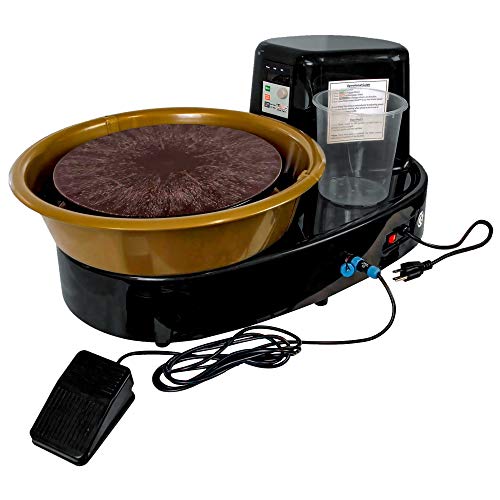
The PW-101 sits between VEVOR imports and the branded tabletop wheels, and its main selling point is a written warranty. U.S. Art Supply lists a 3/4 HP motor, an 11 in head, a top speed of 300 rpm, a reversing spin direction, a two-part splash pan and an LCD speed readout, and includes a foot pedal and an 11 in bat. It weighs 42.3 lb and carries a 1-year limited warranty.
The speed readout is more useful than it sounds: once you find a speed that works for centering or trimming, you can return to the same number next session. The maker does not publish a centering capacity or voltage. A third-party review quotes up to 25 lb, which we could not confirm on the maker's page, and we could not reload the maker's page for this update, so the figures come from our earlier check of it.
- Motor: 3/4 HP (maker figure)
- Wheelhead: 11 in
- Centering capacity: not published by the maker
- Speed: up to 300 rpm, LCD display
- Weight: 42.3 lb
- Warranty: 1 year limited
- Price band: typically $400 to $600 in October 2026; check the live price
Pros
- Pedal, reverse and bat included
- Speed readout
- Written warranty
Cons
- 1-year warranty is short
- Capacity and voltage not published
Who should skip it: buyers who want a published capacity rating and a warranty longer than a year.
5. Speedball Artista: first step up from budget

The Artista is where published specs and a multi-year warranty begin. Speedball rates it at 25 lb of clay on an 11 in head, with a 1/3 HP motor, 0 to 220 rpm on a hand control and a 5-year warranty, and describes it as running smoothly with very little noise. The speed starts at zero, which makes slow trimming easier than on the 60 rpm VEVORs.
The trade-offs: the standard Artista does not reverse (Speedball makes a separate left-handed model), and the foot pedal is an extra purchase. Add the pedal to the price when you compare it with the PW-101, which includes one. For a buyer who throws mugs and bowls a few times a week in a small space, it is a wheel to keep, not a trial. Our tabletop pottery wheel guide compares it with the Shimpo VL-Lite and Aspire.
- Motor: 1/3 HP
- Wheelhead: 11 in
- Centering capacity: 25 lb
- Speed: 0 to 220 rpm, hand control; pedal optional
- Warranty: 5 years
- Price band: typically $600 to $750 at US dealers in October 2026; check the live price
Pros
- Published 25 lb rating
- 5-year warranty
- Quiet
- Zero-rpm start
Cons
- No reverse on the standard model
- Pedal extra
Who should skip it: potters who want to throw large bowls or need a pedal in the box.
6. BTH Sirius BP02: budget full-size wheel with published capacity
If the VEVOR's missing capacity figure bothers you but $1,150 is too much, the BTH Sirius is the middle path. BTH lists a 500 W brushless DC motor with belt drive, a 12 in aluminum head, 88 lb centering capacity, 0 to 300 rpm starting from 5 rpm, forward and reverse, a magnetic two-part splash pan, a detachable waterproof pedal and adjustable legs, with a 5-year warranty. Some dealers list the head at 12.4 in.
For power, BTH states single-phase 110V plus or minus 10 percent at 60 Hz; it does not publish the amps or plug type. The brand has a short service history in the US and dealer specs vary, both covered in our BTH Sirius review. The 12 in head is smaller than the 14 in standard, which matters if you want large bats.
- Motor: 500 W brushless DC, belt drive
- Wheelhead: 12 in aluminum
- Centering capacity: 88 lb
- Speed: 0 to 300 rpm, from 5 rpm
- Warranty: 5 years
- Price band: about $850 to $1,060 at US dealers in October 2026; check the live price
Pros
- 88 lb rating and reverse near tabletop prices
- Slow 5 rpm start
- 5-year warranty
Cons
- 12 in head
- Short US track record
- Amps and plug not published
Who should skip it: buyers who want a long-established US repair network or a 10-year warranty.
7. Speedball Clay Boss: when to stretch all the way

The Clay Boss is the wheel we point to when someone has outgrown a budget model, or knows they will. Speedball lists a 0.5 HP motor, a 14 in head, 100 lb centering capacity, 0 to 240 rpm, a foot pedal, reversing by flipping a plug, 68 lb and a 10-year warranty, with two bats included. That warranty alone is ten times the PW-101's.
Put the numbers side by side. A VEVOR 14 in gives you the same head size for roughly a seventh of the price, but nothing in writing about capacity or coverage. The Clay Boss gives you both, plus a wheel with resale value if you stop. Our Clay Boss review covers it in depth, and our best pottery wheels guide ranks it against Brent, Shimpo and Skutt.
- Motor: 0.5 HP
- Wheelhead: 14 in
- Centering capacity: 100 lb
- Speed: 0 to 240 rpm, pedal
- Warranty: 10 years
- Price band: typically $1,150 to $1,400 at US dealers in October 2026; check the live price
Pros
- 100 lb rating
- 10-year warranty
- Bats included
- Holds resale value
Cons
- Several times the cost of a budget wheel
- Reversing needs a plug flip
Who should skip it: anyone who has not yet thrown and wants to test the hobby first.
The honest VEVOR verdict
VEVOR wheels are the reason many people now try throwing at home, and they deserve a fair hearing. On paper they offer features that used to cost far more: a brushless motor, a pedal, reverse, a basin, height adjustment and a tool set. Owner reports and reviews generally describe them as fine for learning to center and for small pieces. What they lack is information and backup.
What you give up
- No published capacity. VEVOR does not list a centering capacity for the 11 in or 14 in wheel. One review site judges the 14 in comfortable with a few pounds of clay and says people throwing roughly 8 to 10 lb and up will hit its limits; that is the reviewer's view, not a VEVOR figure.
- A 60 rpm minimum. The 11 in and 14 in wheels run from 60 to 300 rpm. Slow trimming, banding lines and opening wide forms are easier with a wheel that turns slower; the 9.8 in VEVOR, the Artista and the BTH all start from zero or near it.
- An unclear warranty. VEVOR's pages offer optional 1, 2 or 3 year protection plans from Xcotton (with AIG) but do not state a standard warranty. Check VEVOR's return and refund policy before you buy, and keep the box until you have thrown on the wheel.
- No bat pin holes. VEVOR's Q&A says its wheels are not drilled for bat pins. You can throw straight on the head, or use a bat system that grips without pins; our pottery bats guide explains the options.
- Thin electrical detail. For the 11 in and 14 in wheels, VEVOR states a single-phase, three-wire connection, and on the 14 in an earth leakage protection device, but does not print the voltage or plug type on the product page. The 9.8 in page states 110V. Use the supplied plug in a grounded three-prong household outlet, keep the cord out of the water, and if your outlet is ungrounded or trips, have a licensed electrician check it. Never alter the plug or controller.
Which VEVOR to buy
Buy the 14 in if you want one budget wheel that grows with you a little. Buy the 11 in only if price is the deciding factor. Buy the 9.8 in if slow speeds matter more than head size, or if the wheel lives on a desk. Sellers on marketplaces such as Home Depot and Lowe's list other budget wheels with similar specs under brands like SVOPES, HUANYU and VivoHome; treat them the same way, and favor the listing that publishes the most figures.
Do cheap pottery wheels work?
Yes, for learning. A budget wheel with a pedal and reverse can teach centering, opening and pulling walls on a few pounds of clay. Where they struggle is sustained load: big lumps of clay, heavy bowls and daily use, where a stronger motor and controller keep speed steady. If your wheel shudders or drifts, our beginner pottery wheel guide covers how to stop a cheap wheel wobbling, and centering technique makes a bigger difference than most people expect.
How to choose a cheap pottery wheel
Most budget listings look alike. These are the points that separate a useful wheel from a frustrating one.
Wheelhead size
The head limits the widest piece you can throw. A 14 in head handles wide bowls and small plates; 11 in suits mugs and bowls; 9.8 in and smaller suit cups and practice. Mini wheels under about 8 in are a different category, covered in our mini pottery wheel guide.
Motor, capacity and speed range
Watts and horsepower are only a rough guide, because controllers differ. A published centering capacity is the better measure, and budget imports rarely give one. Look at the bottom of the speed range too: 0 rpm starts make trimming easier than 60 rpm starts.
Pedal, reverse and controls
A foot pedal keeps both hands on the clay, and reverse lets left-handed potters throw clockwise. Most cheap wheels include both; the Artista includes neither, and the Clay Boss reverses with a plug flip.
Bats and splash pan
Bats let you lift a fresh pot off the wheel without distorting it. Check for bat pin holes and their spacing, or plan on a pinless bat system. A shallow plastic basin splashes more than a deep two-part pan.
Warranty, returns and support
With a budget wheel, the return window matters more than the warranty. Buy from a seller with a clear return policy, inspect the wheel the day it arrives, and run it for a session within that window. A written warranty, even a short one like the PW-101's, gives you someone to call.
Height, stability and water
Budget wheels are light, so they can slide or shake under load. Set the wheel on a solid, level surface at a height where your forearms rest on your thighs. Keep the pedal cord and power cord away from the basin, and unplug the wheel before cleaning it. Wipe up dried slip with a wet sponge rather than sweeping, because clay dust contains silica.
When to stretch to a better wheel
Spend more from the start, or plan an upgrade, if any of these apply:
- You already throw at a studio and want the same experience at home.
- You want to throw more than a few pounds at a time, or large bowls and plates.
- You plan to throw several times a week for years; a 10-year warranty spreads the cost.
- Someone else will share the wheel, or you teach.
- You want resale value if you stop; branded wheels hold it, budget wheels mostly do not.
For what each price tier buys and why branded wheels cost more, see our pottery wheel cost guide. A used branded wheel is another way to stretch your money; our pottery wheel for sale guide has a used wheel checklist.
Sources: VEVOR product pages for the 14 in 450 W (LSFD-515), 11 in 350 W (LSSJ-515) and 9.8 in 350 W LCD (GCJX-008) wheels, including their Q&A sections; U.S. Art Supply PW-101 product page (figures from our earlier check); Speedball Artista and Clay Boss product pages; BTH Sirius BP02 maker page and dealer listings (Sheffield Pottery, New Mexico Clay); third-party reviews and guides compared for coverage: The Pottery Wheel ("Cheap Pottery Wheel"), Cleveland Heart ("Best Pottery Wheels Under $500"), Austin Gallery (VEVOR pottery wheel review); Home Depot and Lowe's budget wheel listings. Specs checked October 2026.